Tag Archives: homesteading

Book Review and a Lactoferment: Daikon Radish Pickles

Standard

I love the book “The Urban Homestead” by my favorite homesteading couple, Kelly Coyne and Erik Knutzen.  Not only do they have a multitude of wonderful homesteading “how to’s”…they can talk about preparing for the zombie apocalypse with humor. 🙂

They have so many great ideas!  They give the details on starting your own mini farm, canning and food preservation, DIY alternative energy sources for your homestead (with a little help, my son just made a rainwater barrel for a Cloverbud 4H fair project), baking bread from scratch, make-your-own cleaning aides and keeping livestock in the city (which I happen to be really fond of!) and on and on…  If you are even remotely interested in being more self-sufficient and living more sustainably…this is the book for you!

I am a big fan of lactofermentation…and when I saw the following recipe, I knew I had to try them!  Before modern day canning, or the ability to freeze, people preserved their vegetable harvest through the lactofermentation process.  Lactic microbial orgamisms create an environment that is acidic and won’t allow bacteria that causes food spoilage to live.  This process also creates alot of beneficial, living, probiotic organisms in your food.  Contrary to popular belief – not all bacteria are bad. 🙂  On the GAPS Diet, we are supposed to eat a lot of fermented foods as a means to reintroduce beneficial bacteria to the gut…and one can only eat so much kraut and kimchi so it was nice to find something else for variety!

The following recipe is for one quart.  This year, I grew daikon radishes in my garden and had a TON – so I made several quarts.  Just adjust the following recipe to suit your needs:
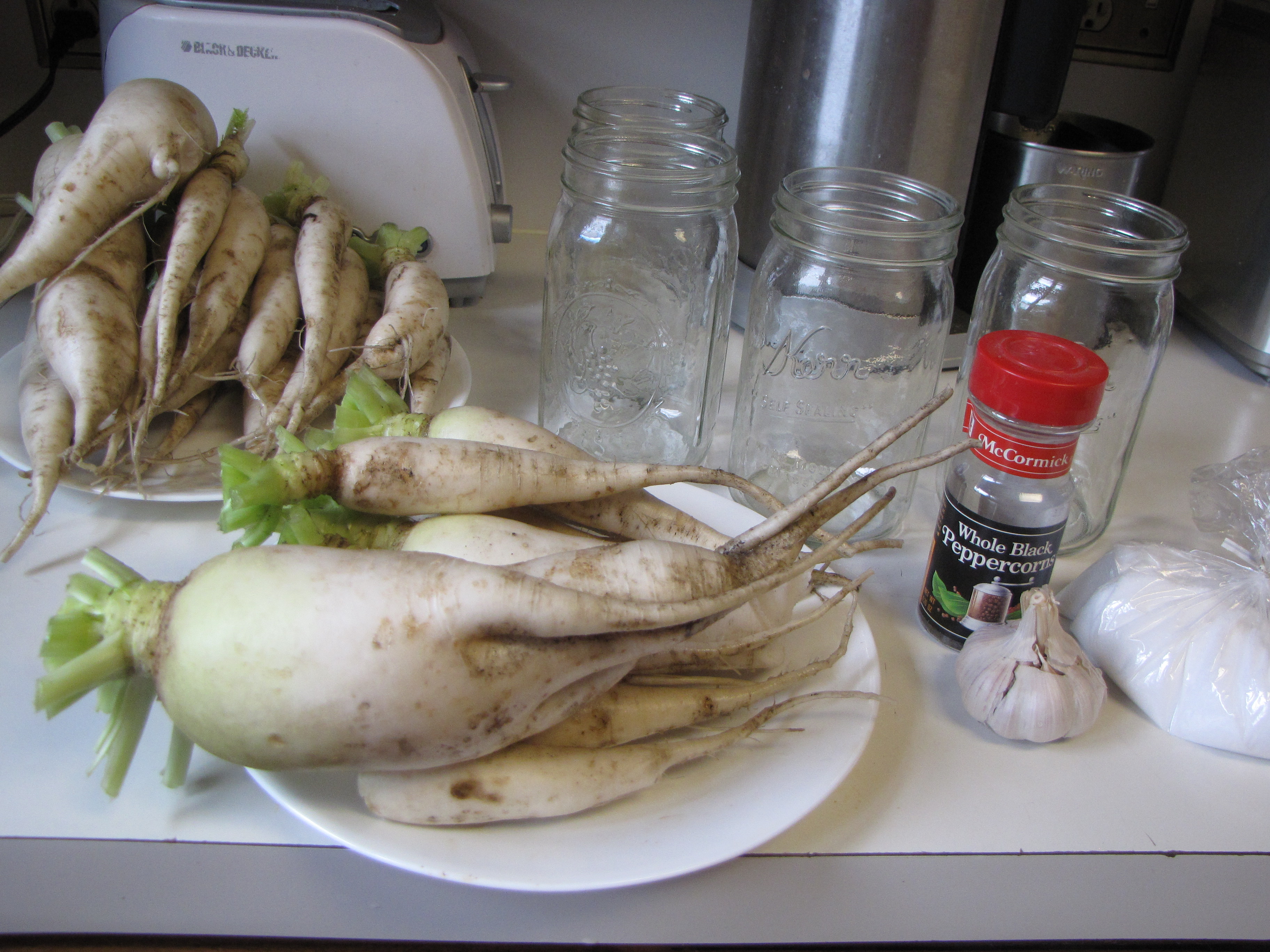
Daikon Radish Pickles from “The Urban Homestead”

Ingredients:

**Daikon radish – enough to fill a quart jar – one big one is usually enough.  Kelly and Erik recommend that you cut them into rounds, quarters or matchsticks – however, I did spears and they did turn out ok.

**One peeled garlic clove and a few peppercorns.  The garlic odor/flavor is assertive, so skip the garlic if you’re not a fan.

**Two tablespoons (or more) of sea salt or any salt that is not iodized.  Iodized salt will kill lactobacillus bacteria and interfere with the fermentation process.

**One quart of water.  Bottled or filtered is best, but the authors have used tap successfully.
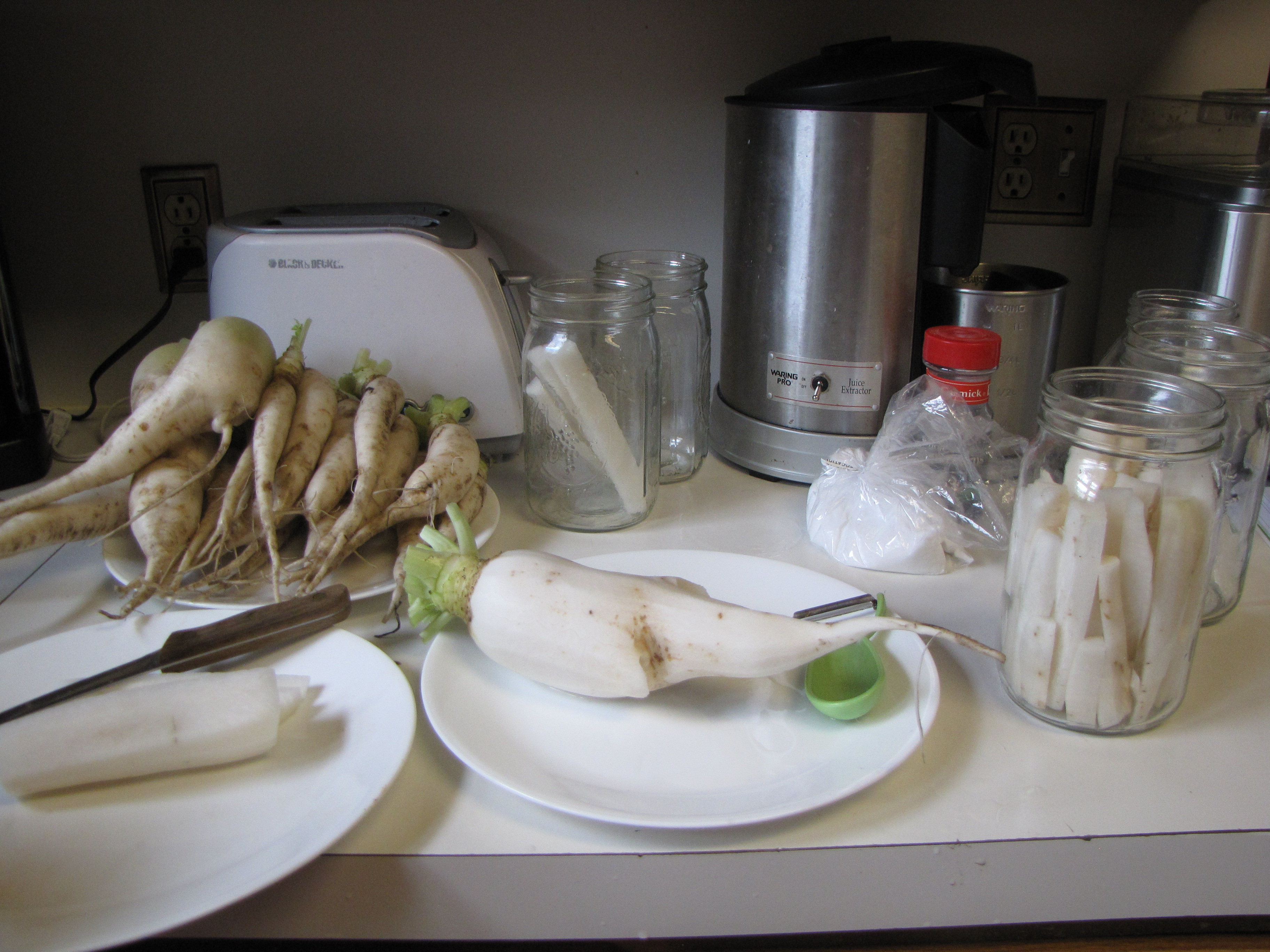
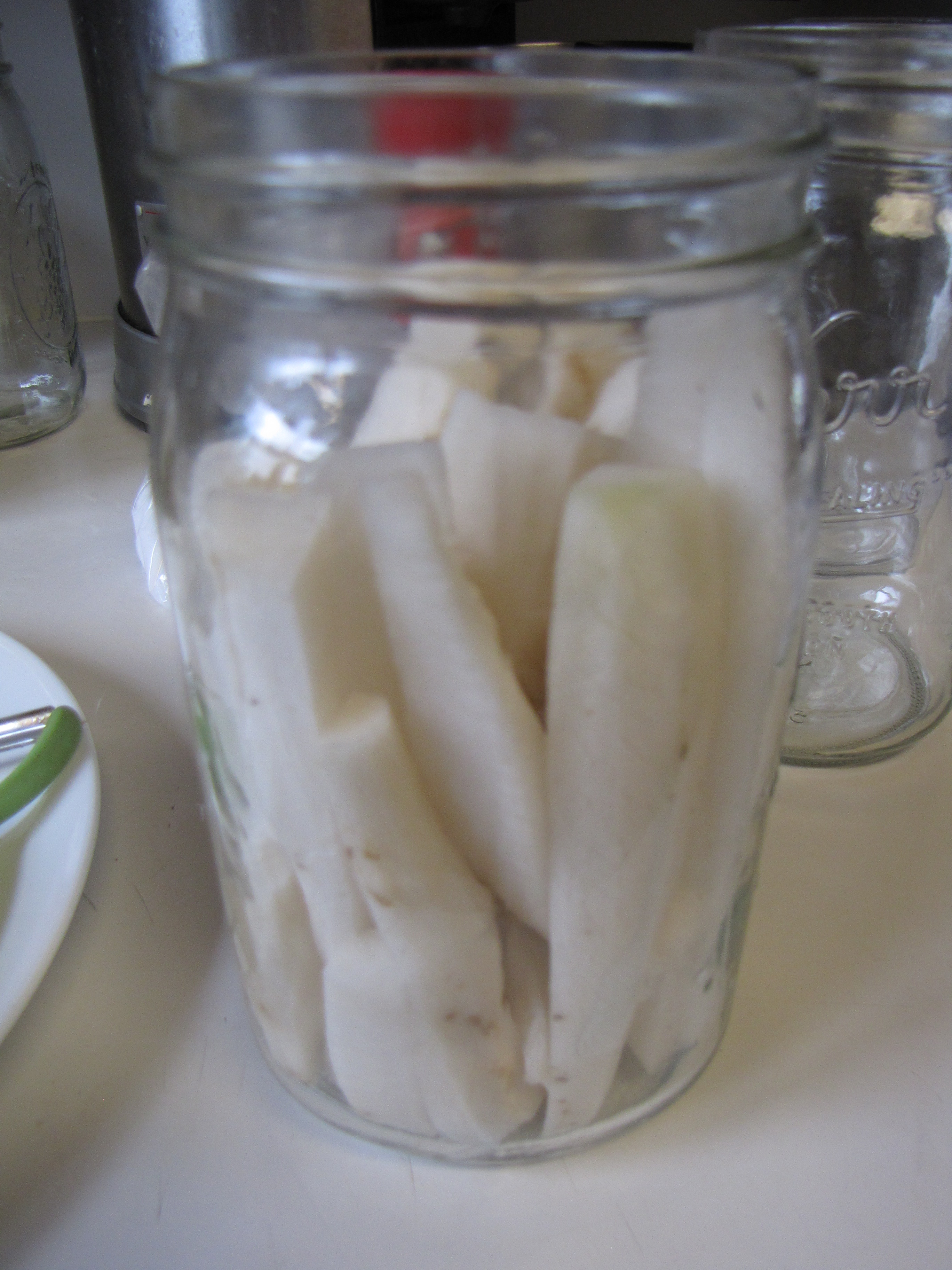
Fill a sterilized quart-sized canning jar with your sliced daikon, and a clove of garlic if you like, and a few peppercorns.  Mix your salt and water together in a separate container and pour it into the jar over the daikon slices, leaving a little breathing space at the top, about a quarter of an inch.  Make sure to pack the radishes tightly, and also that the radishes remain submerged as this is an important key to avoiding spoilage.
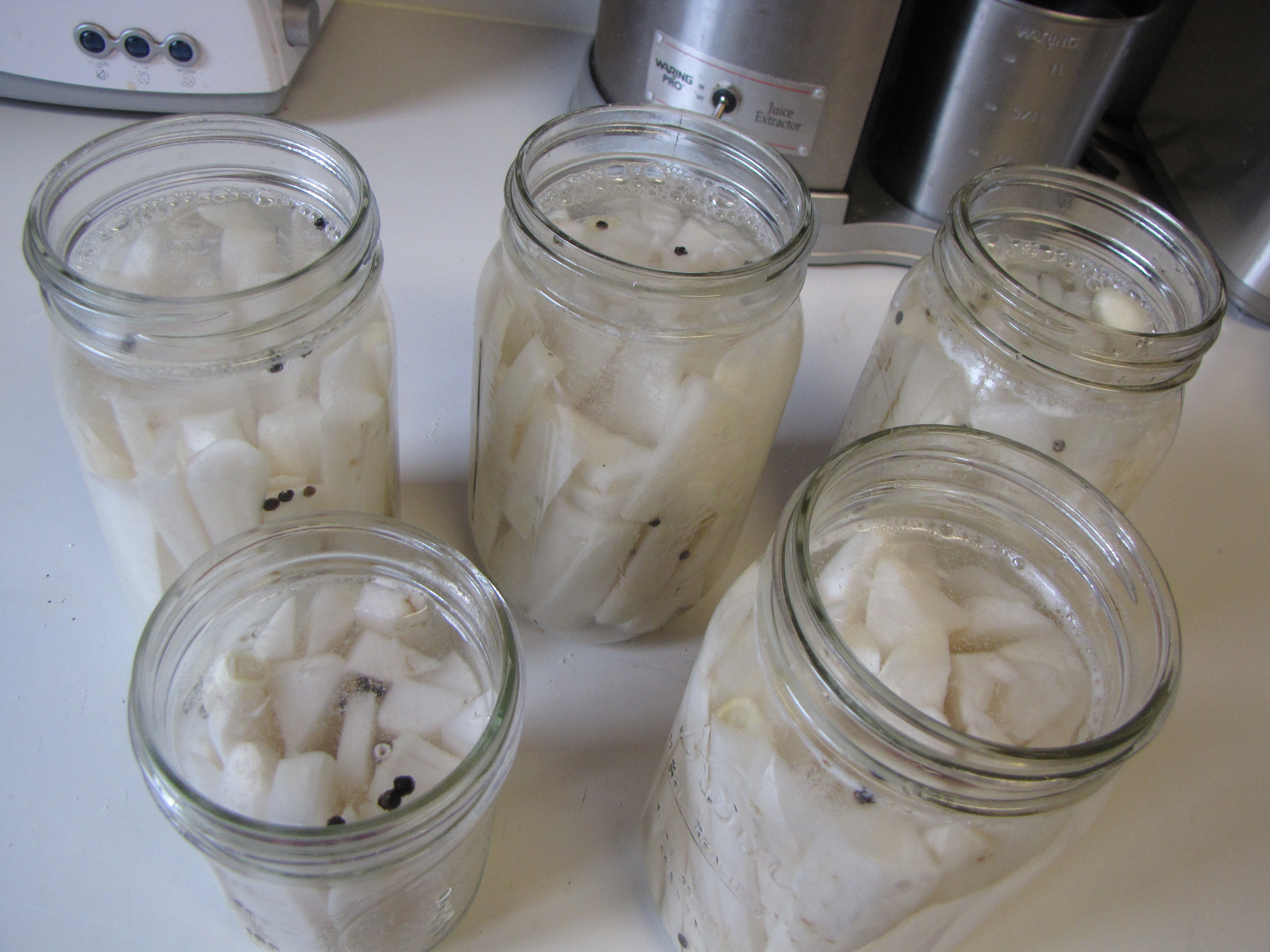
Close the jar tight, and put it in a cool, dark cabinet.  The flavor changes over time, so try opening different jars at different times to see what stage of fermentation you prefer.  The earliest you should try would be three or four days after bottling, the authors usually wait a week or so.  **On a personal note, I left them for a week and when I do them again, I think I’ll try them around four days.  I had one jar that looked kind of funky and I threw it out, but the rest were good.  It was also really hot out, and warm in my house, when I did these and I think that makes a difference.

When you open it there might be some fizzing, which is normal.  My garlic also turned blue, which I also understand to be normal and okay.  The pickles should be crunchy (but not raw, definitely transformed) and pleasantly garlic-flavored.  If they are a little too salty for your taste, you can rinse off the brine before you eat them.  Keep the opened or unopened jars in the fridge to extend the life of your pickles.

**Food safety note.  I know there is alot of controversy over whether to use mason jars or not in lactofermentation.  While a Harsch crock (or other pickling system) is on my Christmas list – I don’t have one now.  If they are:  mushy, funky smelling, moldy or anything else that looks like you shouldn’t eat it…don’t.  The one jar I threw out had turned yellowish…and while it may have been fine, I didn’t want to take the chance.  And if you are uncomfortable with the whole lactofermentation process…you can always go through the canning process but know that the living, beneficial organisms will be killed off.  The Ball Blue Book is a good resource for that type of canning.

Enjoy!

This post was shared at the Healthy Home Economist’s Monday Mania; The Morris Tribe’s Homesteader Blog Carnival; The Better Mom’s Mondays Link Up; The Prairie Homestead’s Homestead Barn Hop; Living with Food Allergies and Celiac Disease Made from Scratch Monday; Real Food Forager’s Fat Tuesdays; Simply Sugar and Gluten Free’s Slightly  Indulgent Tuesdays; Cooking Traditional Foods’ Traditional Tuesdays; Kelly the Kitchen Kop’s Real Food Wednesdays; Frugally Sustainable’s Frugal Days, Sustainable Ways; The Tasty Alternative’s Allergy Free Wednesdays; The Nourishing Gourmet’s Pennywise Platter; GNOWFGLINS Simple Lives Thursday; Real Food Freaks Freaky Friday; The Liberated Kitchen GAPS Friendly Fridays; The 21st Century Housewife’s Gallery of Favorites; Too Many Jars in My Kitchen’s Fill Those Jars Friday; Butter Believer’s Sunday School Blog Carnival.
Chickens in town…why not?!?

Standard

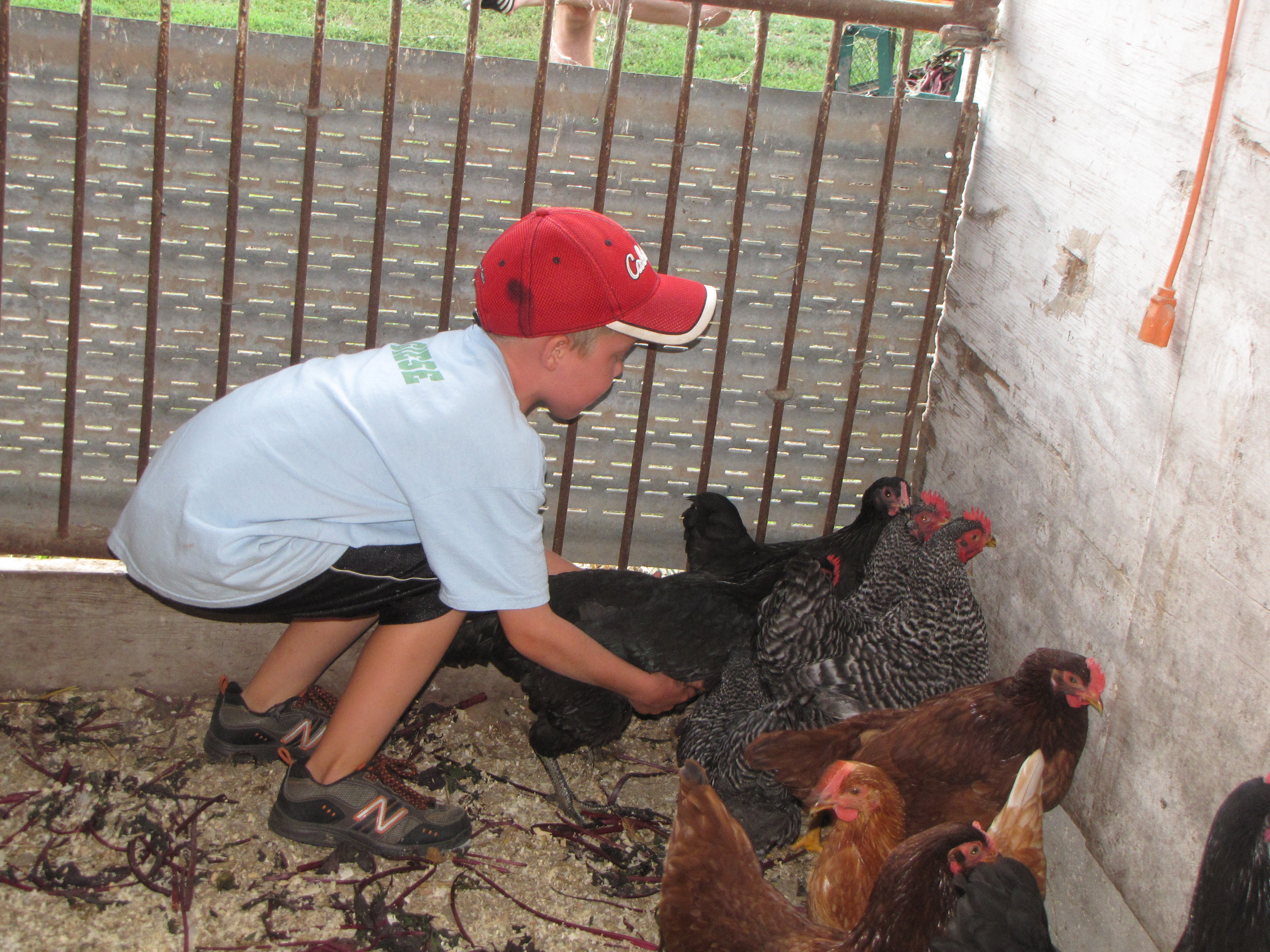
Last weekend we brought “the girls” to town.  Up until now, they have lived at my father-in-law’s farm just a few miles away.  The “girls”, or 7 hens, are now happily at home in a coop in our backyard.  My 10 year old daughter is my guest blogger today…  She wrote this post while we were getting ready for them:

Chickens……..in town!  Why not?!

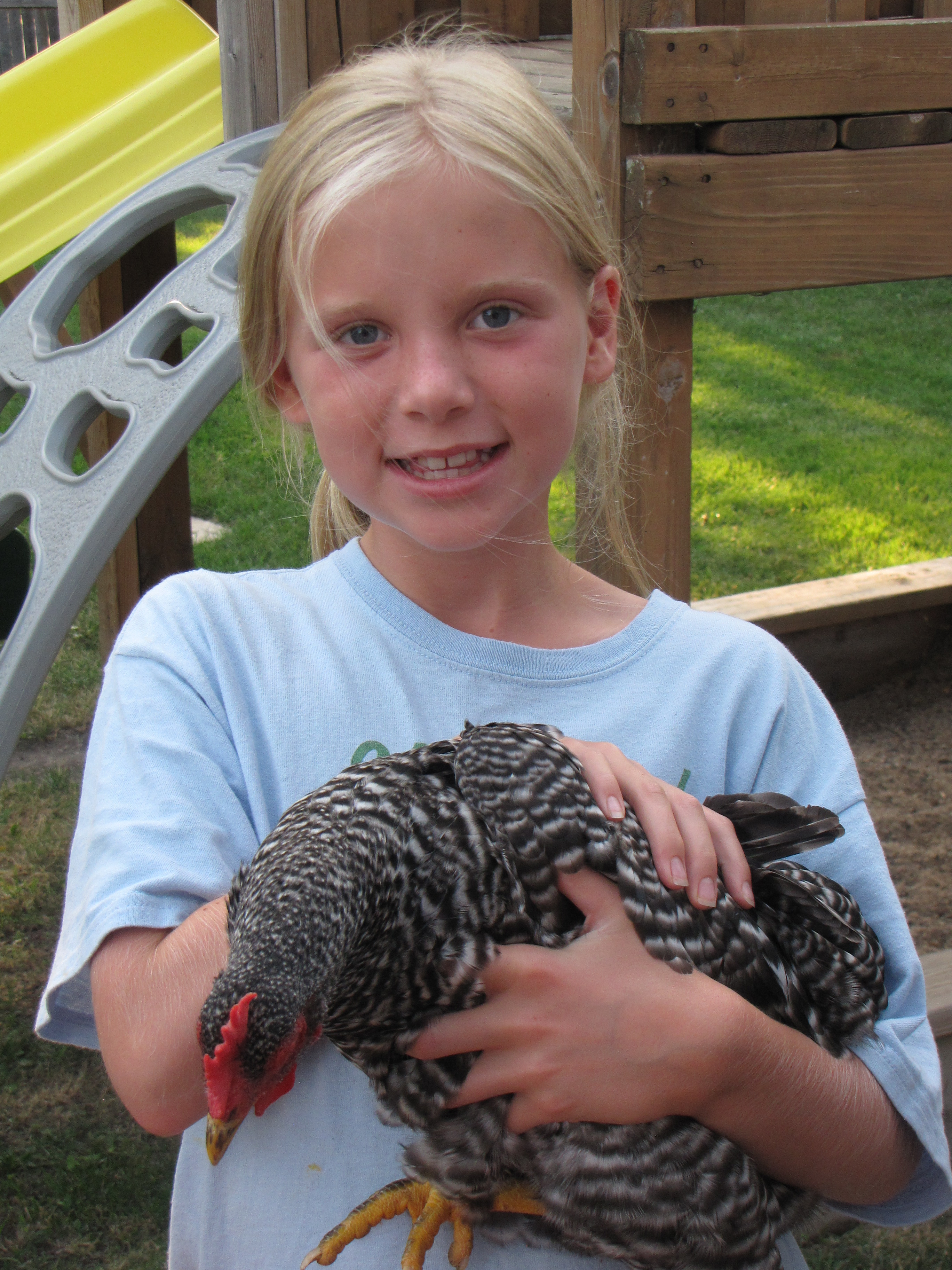
I can’t wait till’ we have chickens in town. My 2 younger siblings, my mom and dad, and I get to fix and pizazz the chicken coop. So excited!!  Anyway, we also get some advantages with the fully developed chickens. What, you say? Well, we get free eggs, something to hold, pet, and study for 4- H. I love to hold the chickens (as long as they don’t poop on me!) One of the big chickens at my grandpa’s farm lets you walk right up to it and pick it up and hold it. Tips for holding chickens – When you grab them, hold their wings down and put the head under your arm so you can see it on the other side. Put your hand under their backside, and remember to stroke the chicken’s back so it knows it is okay.  If you are new to this, you should go for one that is slightly big, and a female. Roosters (males) are a bit scary and aren’t as calm as females. Recently, my little 3 year old sister caught her first chicken! YAHOO!!  Last year I won grand champion at our county fair’s poultry show, and I’m looking forward to practicing with these “classy chicks”! I am very excited for my feathered friends to move into town.

Corralling hens for the big move…

Caught her!

The Chicken Wrangler 🙂

Almost there…

“Gossamer” – Cuckoo Marans hen

Checkin’ out their new digs…

Home Sweet Home!

A note from the Earth Muffin Mom:  This move was not without drama.  The hens…well…didn’t exactly like each other right off the bat.  We never gave this thought because they had all been together since they were a few days old.  The first day, we brought four hens to town.  It was painfully obvious by the end of the second day that the three bigger hens had ganged up on the fourth smaller white leghorn (Miss Toot).   We had a little lesson in chicken psychology – who would know that hens would be bullies in such a planned manner?  The three hung together in a pack, they would not let Miss Toot out of the hutch area, they wouldn’t let her eat or drink, and any time they got the chance they would peck at her head.  She would hang her head and dodge back into the hutch.  It was really sad to watch – frankly I felt like I was reliving high school in a weird sort of way!  We decided to bring in three more white leghorns just like Miss Toot.  At first, it was total Chicken Solidarity.  The four white leghorns seemed to stand up to the three big hens.  For the first day.  The next day we realized that those three big hens weren’t letting the four smaller hens out of the hutch, or letting them eat or drink.  They continued to peck at their heads and feathers.  Right about the time we were ready to take those three hens back to the farm…they all seemed to have some sort of epiphany and are now getting along beautifully.  Don’t know what exactly happened…perhaps they really did understand my threats about ending up in my stock pot???!!?

Our town has an ordinance against having farm animals in town.  We were quite happy to get a special use variance since our kids are in 4-H. The hens are considered “show animals” since they’ll all be making an appearance at the county fair.  Aside from 4-H, I have my reasons for wanting them here.  I can choose their care, and having them here, my kids can do chores and care for their own animals which is great.  I wish they were grass fed, but our yard is small and it isn’t allowed through the variance that we got anyhow.  But…I can feed them all of my kitchen scraps that would otherwise be compost and they are out in the fresh air getting sun (can you say…Vitamin D egg yolks???).  I love walking outside and picking fresh eggs…  Considering that we go through five to six dozen eggs a week…this is a no-brainer!!!

On a more serious note, I think that if people knew just where alot of those pristine white eggs from the grocery store came from, there would be way more people with backyard chickens.  I will not support a system that looks like this:

Chickens in this type of industrial farming conditions (known as battery cages – which according to Wikipedia accounts for about 60% of the worlds eggs) often have their beaks snipped without anesthesia.  The reason that this is done is because living under these conditions, the birds go insane and will peck each other to death, and cannibalize the other birds.  Now…I am not even remotely a vegetarian (although the book “Eating Animals” by Jonathan Safran Foer did push me into a very brief vegetarian stint a few years back)…but I don’t believe that what I eat should live or die badly to end up on my plate.  I encourage you to do your own research on this subject, and not take my word for it.  I try my best to purchase humanely raised meat from local farmers that I know…and also to keep our own chickens for fresh eggs.  Seriously, who would want eggs from these poor things?????

Our girls have been a blast to have (although I could do without the flies)!   A couple are even tame enough already that they like to be petted.  We like watching them “expressing their chickenness” (to coin a phrase from my favorite farmer/author, Joel Salatin).  They make great pets, and I think that the chores are a good way for the kids to see outside their own needs.  It sure beats watching TV!

If this interests you, check it out!  If your city has some type of farm animal ordinance like ours…talk with your city officials to see how you can keep backyard chickens.  Maybe they would  be willing to change an existing ordinance if there is enough interest.  Even a couple of birds would reap big rewards for their owners!

This post was shared on the Healthy Home Economist’s Monday Mania; The Morris Tribe’s Homesteader Blog Carnival; Real Food Forager’s Fat Tuesdays; Cooking Traditional Foods Traditional Tuesdays; Better Mom Mondays Link Up;  Prairie Homestead’s Homestead Barn Hop; Like a Mustard Seed’s Living Green Tuesdays; Kelly the Kitchen Kop’s Real Food Wednesdays; Frugally Sustainable’s Frugal Days, Sustainable Ways; GNOWFLINS Simple Lives Thursday; The Nourishing Gourmet’s Pennywise Platter; Real Food Freaks Freaky Friday; The 21st Century Housewife’s Gallery of Favorites; Too Many Jars in My Kitchen’s Fill Those Jars Friday. Premeditated Leftovers Gallery of Favorites.